



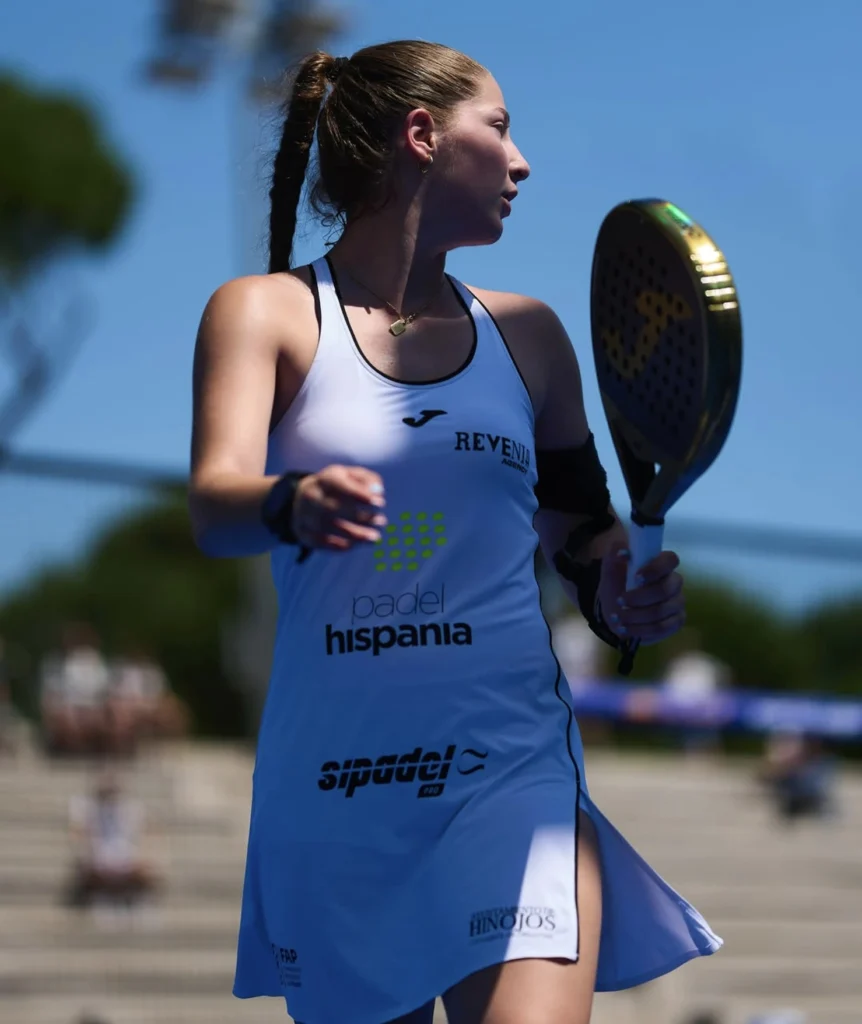
Sport taught María Delgado Medina (Hinojos, 2010) at an early age that talent is merely the starting point. She excelled at road cycling from the age of six, until an accident cut short her career. It was then that padel emerged as an unexpected opportunity. Now aged 16, she is ranked 121st in the FIP world rankings, competes mainly on the CUPRA FIP Tour, has already represented Andalusia and Spain at junior level – having just been crowned champion at the 2026 FIP Junior Euro Padel Cup – and is preparing to make the definitive leap to Premier Padel.
In other words, María is currently one of the rising stars of Spanish padel. With her sights set on a professional career, she divides her time between tournaments, training and her studies, always with the unwavering support of her family. “I’d say my biggest supporters are my parents,” she admits.
It is a hot August morning today and, in a few minutes, María will be stepping onto one of the courts at the SIPadel academy in Seville to train alongside Pablo Loza and two other talented young players from Andalusia. Before the session begins, she has kindly set aside some time in her schedule to chat with us about her current situation, her goals and the challenges involved in making her way in professional sport at such a young age.
María Delgado training at the SIPadel academy in Seville
How did padel come into your life?
My parents had friends who used to play padel, and my mum also had a coach here in Seville. So I’d take the opportunity to go along with her to her training sessions. One day, my mum said to her coach: ‘Hey, give my daughter a go.’ I had a go with him, he encouraged me to carry on, and that’s how I started training in Seville. Little by little, new coaches came along until I ended up at the SIPadel academy, where I train now.
How old were you when you started?
He was eight years old.
And now, at the age of 16, what does padel mean to you?
Padel is my life, my everything. Every aspect of my day revolves around padel: training, studying, my timetable…
You’ve just mentioned your studies. So far this year alone, you’ve competed in 17 tournaments on the Cupra FIP Tour, 11 of them outside Spain, in countries such as Portugal, Italy, France and the Netherlands. How do you manage to balance your studies with the demands of competition?
I’m used to it. Ever since I was little, at school, I used to travel quite a lot. It was within Spain, but I’d travel long distances. Back then, I’d make the most of the half-hour break times to do my homework or get as much done as I could.
When I started secondary school, the academic demands naturally began to increase and, at the same time, I was travelling more each year and over much greater distances, even to other countries. By then I had to perform better and learnt to organise myself as effectively as possible.
This year, for example, there were lots of days when I had plenty of time but didn’t know how to organise myself: I’d say, ‘I don’t know what to do’, and I’d be completely stuck. On the other hand, on days when I had training and got home very late, I knew how to make better use of my time. If I had an exam the next day and got home at nine in the evening, I knew I had an hour to study and that, in that hour, I had to get to grips with a specific topic. It’s a way of organising myself which, to be honest, I wouldn’t do very well in my studies without.
How did you organise your training sessions when you were at secondary school?
When I was at secondary school, I used to train in the afternoons. Some days, if I didn’t have any important lessons, I’d ask my coach if I could go in the morning and ‘sneak off’. Now, in the summer, I train in the mornings, but when I was at secondary school, I usually trained in the afternoons.
You’ve finished the fourth year of ESO and are about to start the first year of Bachillerato. During this time, have you had any support to help you balance your studies and competition?
Yes, they simply let me miss classes. In fact, this year, I’ve probably only been to class for three months at most. But the teachers have always helped me: if I didn’t go to class, I could hand in my homework the day I came back. With exams, for example, I could be away for two weeks and, when I came back, I’d tell them: ‘I’m ready now, I can do it.’ So yes, it’s true that they helped me a lot in that respect, especially by giving me time to get things done.
Have you already decided what you want to study in the future?
I’d been thinking about studying a science degree. I wasn’t sure whether to go for neuroscience, study medicine – because I’m quite keen on those subjects – or do physiotherapy or sports psychology. I’m sure I’ll enjoy anything to do with sport. So I’m in no rush; I’m going to take it easy. I want to focus on padel, make the most of it whilst I can, and then, when it comes to my studies, I’ll take my time and see how it goes.
Your aim, therefore, is to build a professional career in padel whilst continuing your education.
Yes. I never want to stop studying. It’s true that we’re also considering the idea that, over these two years, I should focus as much as possible on padel and put my studies on hold for a few years. But in the end, we’ve come to the conclusion that, by taking it all step by step, I can manage it without any problems. I don’t mind taking a few more years to complete a course or whatever it may be. As I’m a good student, I won’t have any problems either. So I’m in no rush and I’d rather focus more on padel.
The team behind the player
When you say ‘we’, it’s clear that an athlete is never alone, but has a team behind them. Let’s start with your current coach, Pablo Loza. How did your paths cross?
I started, as I said, with my mum’s coach, who was a local lad. Then along came Carlos Díaz, who was my coach and, at the same time, my sports psychologist – and still is. As Carlos worked here at the SIPadel school, Pablo Loza spotted me and I started training with him. I’ve been with Pablo since I was very young; almost my whole life.
In your day-to-day work with Pablo, how is the work organised?
I usually train four days a week. First we do fitness training or padel – the order doesn’t matter – but we usually have both sessions. We often do double sessions: we come in, for example, in the morning and again in the afternoon. In the summer, we might not do quite as much fitness training because it could tire us out ahead of the upcoming tournaments. Even so, we place great importance on fitness, but, above all, we focus on padel.
Pablo usually asks me: ‘Hey, how tired are you from the trip? What tournaments do you have coming up?’ He keeps an eye on things to work out what training intensity I need, which opponents to set me up against, or what I need to work on.
For example, if it’s a Monday, we usually do conditioning or running drills, but if I’ve just come back from a trip, I take a rest. If it’s a Wednesday or Thursday and I’m about to compete, we work on more game situations. If there’s no competition, we can do both conditioning and game situations. On many days we do both at the same time: first the driving range, to warm up, and then match situations; or we do match situations and then finish the session with the driving range. It also depends on the day of the week, and Pablo keeps a close eye on all that.
You’ve also mentioned Carlos Díaz, who, as well as being your coach, is your sports psychologist.
Yes, I mainly work with him on competition. For example, I worked a lot on last year’s Spanish Championships. It was quite an important tournament because it had a lot at stake. As you know, the pressure in sport often plays tricks on you, but he helped me a lot and I was really pleased because I felt great on court. He also helps me with tournaments where there’s a lot of pressure or with things I need to improve, such as my attitude on court. These are things that seem simple and very easy, but which are difficult to put into practice.
SIPadel is an important part of your training. Do you represent the academy when you compete?
Yes. There are many male and female role models; there are girls and boys who are performing at a very high level, both in Premier Padel and on the CUPRA FIP Tour. We are a group that represents the academy.
What services or financial benefits do you receive from the academy?
Financial support usually takes the form of lessons, which do help us out from time to time. We also have a female physiotherapist who trains here, and I get on really well with her. I usually go to see her because, as well as trusting her, she’s very good at her job. I tend to go when I’ve got an injury or just to unwind.
And what about nutrition and sports supplements?
It’s true that I need to start taking supplements, but I haven’t really got into it yet. My fitness coach is already giving me a hard time and telling me, ‘Look, you’ve got to start now.’ My brothers have studied this stuff too and they’re giving me a hard time as well, but anyway, I’m taking it in my stride.
Career management and the need for professionalism
Making the leap to professional padel involves making lots of decisions off the court. Who is in charge of managing your career?
It’s mainly my head coach, Loza, and my parents who take care of that. Obviously, you have to think about the financial side of things too; you can’t just say, ‘This tournament looks great! I’m going.’ No. You have to think about your partner, the ranking points and the financial side of things. And then there’s my decision: ‘I want to play with such-and-such a player’ or ‘I have the option of playing with such-and-such’. So I discuss it with my coach and, above all, with my parents, and we sort it out together, more or less.
Speaking of doubles, you’ve just played a FIP tournament in Barcelona alongside the Portuguese player Clarinha Santos. How did that opportunity come about?
Clarinha is a bit older than me, but she’d already been playing on the FIP circuit for a while. Eventually, you get to know everyone, because you keep bumping into people at tournaments, playing against them and so on. As you get to know these people, you make new friends. I’d played against her once before, and I’d actually known her from before because she was with a girl my age. So, when we bumped into each other, the idea came up: ‘Hey, do you want to play with me?’ We realised it was a good option and decided to compete together.
Who made the first move?
It was as if we both happened to be in the same place at the same time. I was experimenting with girls and she’d been seeing another girl for a while, but the idea of playing in the tournament came up and we both said, ‘Right, come on, let’s do it.’
When you’re faced with an important decision like this, do you ask your parents and your coach for their opinion before taking the plunge?
Yes, always. I always say, ‘OK, I like the idea, but I want my parents and my coach to give their approval.’
Do they help you with sponsorship as well?
Yes, of course.
Who are your current sponsors?
I’ve got the Hinojo Town Council on board, as well as Revenia Agency, which is also the agency that runs the SIPadel Academy here. They help me with all the advertising, photos and so on. They’re very good at what they do and really lovely people, too.
Then there’s Padel Hispania, which sponsors courts, mainly in Portugal, although they’re expanding throughout Spain and growing all the time. It’s one of my very good sponsorship deals.
Then there’s SIPadel, which is the gym that helps me with my training, and Joma, which has provided me with all my sports supplements – it’s an incredible brand, and I highly recommend it.
And, well, I’d say my biggest sponsors are my parents, because they usually cover all the costs involved. So they’re usually my biggest sponsors. For example, when it comes to travelling, for the time being, my parents cover the costs because there aren’t any sponsors to help with that aspect.
Support for youth sport from the federations
Andalusia is renowned for its support of youth sport. On 17 August, you were at Raquetas de Mijas after being shortlisted to represent the region at the Spanish Under-18 Regional Teams Championship. What support does the Andalusian Padel Federation (FAP) provide you with?
They provide financial support at the end of the year based on the tournaments you’ve taken part in and your results – the most important of which are the Andalusian Championship, the Masters and the national team. It also depends on having met certain requirements, such as wearing the FAP emblem.
Roughly how much are we talking about?
It’s a bit of a help. I can’t put an exact figure on it, and I don’t want to say anything ridiculous, but if I were to speak from my own experience, I’d say between 100 and 200 euros. It’s not much because they’re a very large federation and they can’t focus on each individual. But they do help, and, to be honest, it’s much appreciated, because right now things are very tough financially.
You’ve also had the opportunity to represent Spain at the European Junior Championships. Along the way, did you have the support of the Spanish Padel Federation (FEP)?
Yes, but it’s different. They usually provide quite good support with studies, specifically for high-achieving students. For example, this year I can do my A-levels online and, as well as that, take one or two subjects and work through them bit by bit so I don’t have the pressure of having to rush through everything.
Looking ahead
What’s your next sporting goal?
I’d say it’s a case of taking it step by step and getting more and more involved in Premier Padel. It’s true that the FIP tournaments are getting tougher all the time, but, at the end of the day, if you want to make it to Premier, you have to start there. The issue of points and playing partners is more complicated, so it’s a matter of working your way up the ranks bit by bit.
If you could choose any female player to have by your side, who would you play with?
If I had a choice, it´d be the number one in the world. But, obviously, that’s very complicated. It’s all very difficult to achieve. You can take it step by step, but very few people actually make it to the top, so you have to bear that in mind. You have to fight as hard as you can and push forward as far as you can. That’s why I wouldn’t have a fixed idea about my teammates. As I progress, whoever comes along at that moment and is the best option is the one I’ll play with. And, bit by bit, I’ll keep climbing the ranks.