




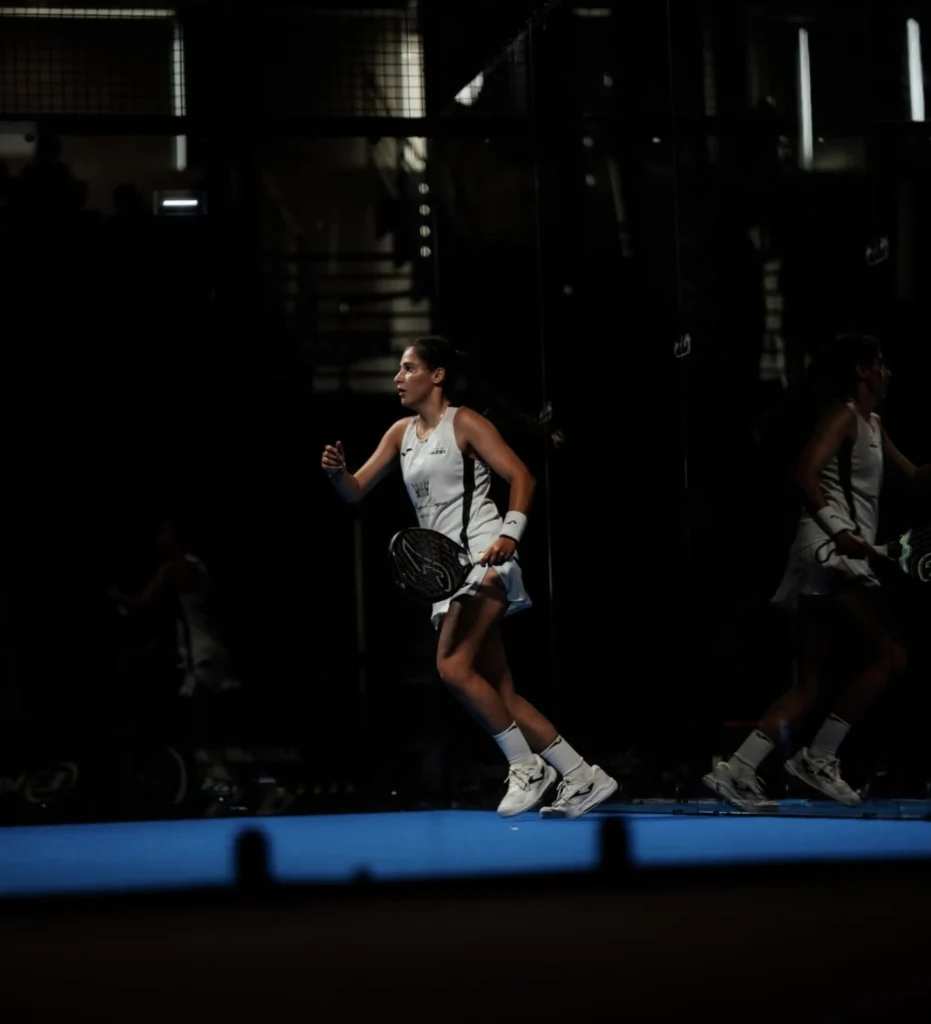
The racket lies next to a bottle of water whilst shouts of celebration ring out from the stands. Laura Luján (Seville, 2005) has just secured her place in the semi-finals of the FIP Silver tournament in Vila Real de Santo António. At the age of 21, she divides her time between two arenas that demand the same precision: the padel courts and the medical school lecture theatres. In one, she is ranked 45th in the FIP world rankings; in the other, she is in her second year of her degree course.
Her journey in the 20×10 format began as a family game during the summer holidays, but it soon became a calling. An Under-18 world champion in Paraguay (2023) and winner of five CUPRA FIP Tour titles in 2025, she has already added another FIP title to her tally this year in Norway. Her schedule alternates between the main Premier Padel circuit, the secondary CUPRA FIP Tour, and, when the opportunity arises, representing Spain, as she will do in July at the World University Championships in Málaga.
In Portugal, we took the opportunity to chat to her about her goals, her profile as a player, the sacrifices required by professional padel, the economics of the circuit and the challenge of building a future both on and off the court.
How did padel come into your life?
I’ve been playing padel practically all my life. I started when I was three or four years old. My grandfather loved the sport, and there was a padel court on the beach where we used to spend our summers. I’d join in and play with him, and everyone would say, ‘That girl’s got a knack for it; she’s got what it takes.’ So my parents decided to enrol me in padel lessons, and I really enjoyed it. And here we are.
Did you feel right from the start that this was the sport for you?
The truth is, I was more into football. But my parents would say to me: ‘No, no, padel – we know you’re really good at it.’ And it’s true that I love it, although I enjoyed both sports. But as I started competing at junior level, when I was about seven, I realised I was good at it and that I was enjoying it more and more. There came a point where, if it rained or I was ill and went a day or two without playing, I’d be absolutely gutted. I just had to play padel.
What does padel mean to you now?
It’s my life. After all, I’ve been competing since I was very young and almost all my friends are from the world of padel, because we’ve always been travelling and training together. So padel is my job, my day-to-day life, my circle of friends… everything.
How did your family react when you decided to pursue a career in professional sport?
My parents were always very clear that I had to start my university degree first. They told me: ‘Get into university, and then, sure, you can do whatever you like.’ The only thing they asked of me was that I passed my exams bit by bit, without rushing. So I played in the lower leagues until I got into university, and once I was studying, I started playing in the Premier Padel league. As long as I don’t neglect my studies and keep working my way through my degree, my parents are happy.
Speaking of your university studies, what exactly are you studying?
I’m studying medicine and I’m in my second year.
A degree course that demands a lot of hard work and requires you to be on campus for your work placements. Do you prioritise your studies or padel, or do you try to strike a balance?
Right now, my priority is padel. That said, if I see that there’s a chance I could sit an exam because the dates work out, I’ll study at home when I’m not training, just in case the opportunity comes up suddenly. But, at the moment, padel is my priority.
Do you receive any support from the faculty?
Zero. I’ve been lucky enough to come across a few lecturers – I think it’s literally happened with three lecturers out of all the modules I’m taking – who have actually helped me, in the sense of changing an exam date or, perhaps, letting me swap practical sessions with classmates so I could go straight to the one I was able to attend. But I’ve had almost no support. In fact, I’ve failed subjects because I haven’t been able to attend practical sessions or because I simply wasn’t allowed to change the date of an exam.
Have you thought about what you want to do once you’ve finished your medical degree?
Personally, I’m drawn to specialisms such as surgery or psychiatry. I like anything that involves action and movement. The idea of spending the whole day sitting in an office doesn’t really appeal to me.
Is your plan to finish your degree, pursue a career in padel whilst you can, and then practise as a doctor?
Yes. Unless I do really well at padel and don’t need to practise, although that’s unlikely.
Why are you so sure you need a Plan B?
Because there are too many variables that could change everything. You could get injured, hit a rough patch, the tour could change – after all, dates keep changing, they might run out of money… – or players of a very high standard might emerge, causing you to suddenly drop down the rankings and not earn any money. I think there are so many things that could go wrong that it’s good to have a plan B, just in case.
The path to professionalism
You’re currently training in Seville. Do you intend to stay in Seville?
Yes, because I’m studying for my degree there. I also live with my parents. I’ve often thought about moving to Madrid, as many players do, but in the end I spend a lot of time travelling, and the players I’d be training with there are the same ones I’d then be competing against every week. And to be honest, it’s not quite the same coming home to your parents’ house after two weeks of competition as it is returning to a flat where you live on your own in Madrid or wherever.
How did your routine change when you decided to pursue a professional career in padel?
At first, nothing changed. As I didn’t have enough points to qualify for Premier Padel, I started playing in FIP tournaments. I trained three days a week, didn’t do any specific fitness training and didn’t follow a particular diet. What’s more, I was doing very well at university and passing all my modules with excellent marks.
Until one day my coach asked me: ‘What do you really want? To commit to padel or to focus on your career?’ I replied that I wanted to commit to padel. He then told me that, if that was my goal, I’d have to change a lot of things and take it much more seriously. And that’s when I made the change: I started training morning and afternoon, found a fitness coach and began paying much more attention to my diet.
At the moment, you’re working with two coaches: Javi Peña and Pablo Mozo.
Yes. In the mornings I train with Javi Peña at La Red 21, and in the afternoons with Pablo Mozo. I’ve been training with Pablo practically all my life. I started with him when I was about 10 years old and we’ve continued to work together, on a more personalised basis. He has his own courts and very few pupils; he selects the players he wants to work with. The truth is that he has another job and plays padel out of passion.
In the case of La Red 21, do you represent that academy when you compete in a tournament?
No, I don’t represent any gym, and in fact, when people ask me about my training sessions, I always mention the coach’s name rather than the gym’s.
Does training at a major academy bring any financial benefits to the players?
Not directly. Perhaps the upside is that, as there are so many players, if you take the coach to tournaments, the costs are much lower. In the end, on the tour I took Javi on, it was just Victoria Iglesias and me; naturally, the costs were much higher than at academies such as Diagonal in Madrid, which has 50 players on its circuits.
In a sport where you have to organise travel, training sessions, competitions and find funding… Do you have someone who manages your sporting career, or do you do it all yourself?
Yes, I have an agent. Her name is María Wakonigg. I started working with her because she’s a friend of my coach, Pablo Mozo. When I won the Junior World Championships, Pablo told her about me. Although she mainly represented players on the professional circuit, as I wanted to break into the circuit myself, we started working together and have been doing so for about two or three years.
The truth is, I’m really happy. Above all, she helps me secure sponsorships; as she knows everyone, she introduces me to more people, more sponsors. Perhaps, if I tell her I’m feeling a bit down because a certain player has written to me, she’ll also give me advice about my teammates. And then, at some tournaments, she comes along with me too.
Let’s talk a bit more about sponsors. Who are your current sponsors?
I’m sponsored by Joma, who are my main sponsor, and things are going really well for me. I’m also sponsored by Apartamentos Playa del Duque in Marbella (a sponsorship deal secured by María), and by Santify Nutrition, who provide me with sports supplements.
How important are sponsors in a career like yours?
A great deal. Ultimately, they form the foundation, because as the professional circuit depends on the results you achieve, you don’t have a fixed monthly income. One month you might do really well, and the next you might do really badly. So sponsors provide that security to cover the cost of training and everything else. It’s like having a basic salary that allows you to carry on.
A player’s DNA and competitive strategy
Let’s talk a bit more about your profile as a player. How do you prepare for a professional tournament?
The truth is, I always try to stick to the same routine. I hardly change a thing just because there’s a major tournament coming up. I train in the same way, stick to the same diet and follow the same schedule, whether I’m playing in a Premier Padel or a FIP event.
Do you analyse your opponents before matches?
The problem here is that the draw is announced far too late. For example, in Argentina I play on Tuesday or Wednesday, and the draw isn’t announced until Sunday. That means we only have one or two days to prepare for our opponents, which makes it tricky. There’s no time to practise specific plays because you don’t even know who you’re going to be playing against. It’s a bit of a pain.
At this FIP Silver event in Vila Real de Santo António, you’re sharing the court with Ana Catarina Nogueira. How did that opportunity come about?
At the start of the season, she wrote to me asking if we could play together. At the time, I said no because I wanted to continue playing with Leticia Manquillo. We’re the same age, we’re really good friends, and we’d been getting some great results.
To be honest, Ana Catarina’s invitation was a significant opportunity because she has a great deal of experience and is a seasoned professional, and it would have allowed us to enter the main draws straight away, but I preferred to stick with Letícia.
Shortly afterwards, Leticia decided to change partners. So I wrote to ‘Portu’ again to tell her that I’d been dumped and to ask if she was still looking for a partner. I told her I’d be delighted to play with her… and here we are.
What are your plans? How long are you going to play together?
We decided to bring this project to an end after the tournament in Argentina.
What happened?
I’ve been given the chance to play alongside Araceli Martínez, who’s ranked 32nd, and that means a lot. She’s younger, has far more ranking points, and I’ve always really liked her as a player – because of her style of play and also as a person. I realised it was a great opportunity and, what’s more, she’d made it into the main draw, so I thought: ‘I’ve got to team up with her.’
Speaking of partnerships, since you started competing in the FIP and Premier Padel tournaments in 2024, you’ve already played alongside 11 different female players. How do you view this constant change of partners?
I think I’m a very easy team-mate. I always try to see the best in everyone and I like learning from my team-mates, so I adapt quickly to any player. Obviously, I’d like to have a stable partnership with just one partner, but we know how the circuit works: if things aren’t going well, you look for a change, or if an opportunity like this comes up, it’s hard to say no. The other player understands that too, because, at the end of the day, you do it to develop on the circuit. So I think I adapt well and don’t find it difficult to play with different types of players.
Looking at your season so far, you’ve played in more FIP tournaments than Premier Padel tournaments this year. Is that part of a strategy?
Yes, although it’s also worth bearing in mind that there haven’t been many Premier Padel tournaments this season. I think, so far, I’ve only missed two Premier events, and both were P2 tournaments: the one in Gijón and the one in Asunción, which is taking place right now.
But, strategically speaking, going to Asunción now and then on to Argentina would mean being away for two weeks. If I were to lose in the first round, I’d have to stay in Paraguay for the whole week waiting before heading to Argentina, and that would be very tough.
But, as the dates coincided with the FIP Silver in Porto, after talking to Ana Catarina, we said: ‘Come on, we’ll have more time to train, we won’t have to be away from home for so long, and we’ll be playing in a FIP event.’ What’s more, for example, in Porto we reached the semi-finals and earned the same number of points as we would have if we’d been knocked out in the first round in Asunción, but without having to spend six days on a break.
It is therefore a question of strategy, but in every respect: not just for the points, but also for the money, and so on.
Do you think the situation in the Middle East could affect the Premier Padel circuit?
Yes, in fact, it’s already having an impact. The Doha Major, which was the first of the year, ended up being cancelled. What’s more, there have been changes to the calendar. For example, the Pretoria tournament has been upgraded from P2 to P1, and the Kuwait tournament – which is also home to the Rafa Nadal Academy – has been upgraded from P1 to a Major. So it does have an impact in the sense that we’ve been deprived of a prize that, on top of everything else, was the main one. But, for the time being, the circuit has found solutions, and now we’ll have to see what happens in the future and whether we’ll eventually be able to compete there again as normal.
If the situation were to become more complicated, would it be feasible for a player to focus solely on the FIP circuit?
Honestly, no. You almost always lose money at FIP tournaments. Ultimately, in Premier Padel, if you’re in the main draw, they cover everything apart from your flight, and you also get a fixed salary, so you usually come out ahead or, at worst, break even. Unless, for example, the cost of living in the town where the tournament is held is extremely high, but normally you tend to break even or come out ahead.
However, with FIPs it’s very difficult, unless you win the tournament and the hotel, meals and transport have worked out cheaply for you. At the end of the day, if it’s about earning points and climbing the rankings, FIPs are brilliant, but not for making money.
What do you think about the launch of the Pro Padel League?
It’s a project that catches your eye, because it’s a huge amount of money and you think, ‘I’m on’. But I’m very young and I’ve got a long way to go.
The PPL has a different system, based on clubs, with a fixed salary, which offers greater security. But I play on the Premier Tour not just for the money — which, obviously, I want to earn so I can make a living from padel — but because it’s the main circuit. At the end of the day, if you want to make a name for yourself in professional padel, you have to be there. The PPL pays well, yes, but it’s an American circuit and it’s still in its infancy.
What’s more, we’ve already seen cases like the A1 circuit: it seemed very solid, it was very lucrative… and then it disappeared. If something like that happens, you’re left with just two Premier Padel points and have to start from scratch. That’s why, at the moment, I prefer to stick with Premier Padel, and we’ll have to see how the PPL develops over the coming years.
From the past to the future
What sacrifices have you had to make to get this far?
Mainly, giving up a large part of my social life. Of course I have friends, but the usual sort of thing – going out for a weekend of partying or to a nightclub… I can’t do that. Actually, I could, but I don’t drink, I don’t smoke, nothing; I just drink water. And when I come back from a competition, after a week or two away, all I want to do is lie on the sofa, wrapped in a blanket, put on Netflix and relax. I really can’t be bothered to get dressed up and go out. And of course, that means your circle of friends shrinks, as you’d expect, although it also helps you see who’s really there for you.
Another significant sacrifice is time with my family. I see my parents because I live with them, and when tournaments are held very close to home, they usually come along with me. But I only see my uncles, aunts and cousins at Christmas and not much else. I’ve missed weddings, christenings and other important family celebrations because they clashed with competitions.
And then there’s university. After training all day, the last thing you feel like doing is sitting down to study, but you’ve got to do it. It’s got to be worth it, hasn’t it?
What goals have you set yourself for this year?
Rather than a specific position in the rankings, my main aim is to establish myself in the main draws. In other words, to be able to qualify for the main draw and not have to worry every week about whether I have enough points, or whether I’ll be in the qualifiers or the main draw… That gives me much greater peace of mind.
The Mediterranean Games are taking place in August. Have you had any calls?
No, not yet.
Would you like to be invited?
Of course I will. This summer I’m going to represent Spain at the World University Championships, which is already a huge source of pride. Only two pairs compete at the Mediterranean Games, so it’ll be tough because the highest-ranked players will be there first. But, of course, if that opportunity ever comes along, it would be an honour.