



The scoreboard shows 5-4 already in the third set; one more game would be enough to close the match. Next, on the same court, the men's final. How do both finals differ? In absolutely nothing. How does the recognition of their effort differ? Depending on the tournament, in absolutely everything.
They have already been playing for one hour and fifty minutes. María (a player on the professional circuit who does not want to be identified and to whom we assign a generic name) prepares to serve, but cannot. The audience will not allow it. "Silence, please," the referee repeats four times in response to the shouts and whistles coming from a packed stand.
In the stadium, the echo of the 35 million amateur players are currently engaged in the sport. For them, Padel is no longer a fad, but a sport that has come to stay. For them, on the court there is no room for gender, age, or race, but only for human connection.
Shortly, the President of the International Padel Federation (FIP), Luigi Carraro, will be heard stating precisely that "no other sport in history has grown and expanded as quickly as Padel"; that one hundred federations have already been reached across the five continents and that, "as of today, the discipline meets all the requirements to be Olympic." Beside him, Nico Cruz, Coordinator of the FIP Communication Strategy, will support the importance of bringing Padel "to more and more countries, making it more international, closer to people, so that new players emerge in all parts of the world."
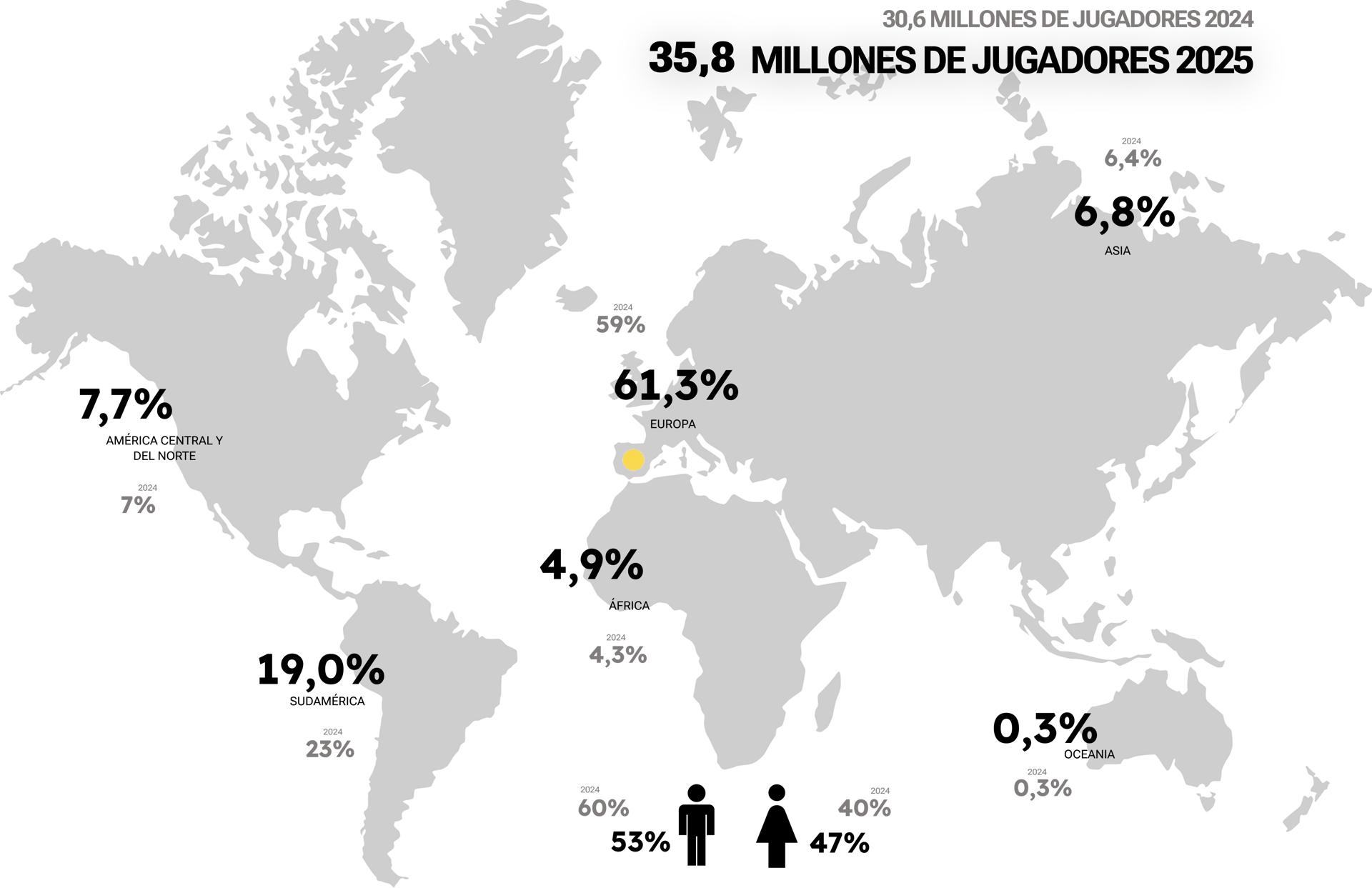
Comparison between the global distribution of padel players in 2025 (black) and in 2024 (gray), according to the data from the FIP World Padel Report 2024 and 2025
With a view towards 2032, the international federation is aware that the path to Mount Olympus is supported by the same two legs: the male and the female. Therefore, it will not miss any opportunity to showcase its intention to 'create an environment of equal opportunities, regardless of gender.'
A conviction reinforced by a recent past that clearly points to the only possible direction: it has taken 124 years for, finally, full gender equality and parity to be achieved for the first time at the Paris 2024 Olympic Games.
What can be learned from this? That, although the event already stood out for holding the men's and women's finals on the same day and for recognizing equal merit by awarding the same three medals to both women and men, it now also stands out for ensuring the same opportunities for access to the competition: for 19 days France brought together 5,250 male athletes and 5,250 female athletes.
From that point onward, there is no turning back.
Padel is still a young sport —with less than a century of history—, but its objectives are ambitious. And perhaps it is precisely its youth that gives it the necessary flexibility to be shaped by the hands of a society in which values such as respect, equality, and human dignity stand out.
Perhaps it is also that same youth that allows it to free itself from the stigmas of the past and to begin writing new precedents regarding the presence of women in professional sports. It is to that hope that the players cling, whether because they defend individual justice, or because they trust in the FIP's discourse in its full ascent towards Olympus.
The match continues. Spirits are calming down, and María can now serve. She bounces the ball once, twice, three times on the ground before hitting it. She was barely five years old when her parents enrolled her in padel classes. She could hardly have imagined then that what initially came into her life as an activity to keep her body and mind healthy would, years later, become her profession and her way of life.
The journey has not been easy, but she is now in a considerable position in the rankings. To reach this point, she began her career in the national championships before making the leap to the international circuit. Nonetheless, she acknowledges the fortune of having grown up in Spain, one of the countries with the greatest Padel tradition, where – she assures – she always found the doors open.
Behind the player's spike, there is a federation that supports her. In the offices of the FIP, guidelines are being drafted today that encourage national federations to promote "equal prize money in their national competitions" as a way to increase female participation.
However, the reality on the ground shows that some federations have not needed Olympic motivation to achieve it, but had been moving in that direction for years. While countries such as Great Britain, France, or Portugal already reflected that sensitivity in their regulations, the Spanish Paddle Federation (FEP) has made equality one of its hallmarks.
With a growing number of federal licenses issued (117,508 in 2025 – 8,468 more than in 2024 –), from within the institution, its vice president, Jesús Vázquez, explains it clearly: 'At all times, all the activities carried out by the FEP are governed by equality in every respect, both in the men's and women's categories.' From youth, senior, and veteran tournaments to national teams, 'all competitions run in parallel for men and women, and the treatment between both is identical in all areas: logistical, sporting, and structural.'
The FEP's commitment to professional women's sports goes even a step further. The federation has a specific support line: the scholarships of the Women and Sport program, developed in collaboration with Iberdrola, and dedicated solely and exclusively to female athletes.
But the effort to balance access opportunities is not limited to the national level. In the south of the country, the Andalusian Paddle Federation (FAP) it is another benchmark of this care: “Padel keeps growing and we continue progressing and adapting at the pace that the game and the athlete indicate to us,” comments Francisca Rojas, the vice president of the institution.
Faced with the talent that emerges from the fertile land of the south, the Andalusian federation focuses not only on the categories of seniors, veterans, and clubs, but also places emphasis on balancing the scales from the earliest ages. It does so through the youth category and scholarship programs in which the financial amounts are exactly the same for boys and girls.
A model that seeks to translate the equality of discourse into practice from the very first steps in competition.
María throws the ball into the air and executes the serve. After the return, a wall exit. The response is a down-the-line shot, followed by a lob to the back, a backhand to the corner, and a cross-court shot from side to side with an impossible angle to sustain. The 40-30 is made.
Now, about to serve to close the match, all the effort made comes to mind: his body bears the weight of all the hours accumulated on the court, the daily training sessions—double, if not triple—the long and constant travels that wear down a physique forced to readjust to time zones in perpetual change; all the expenses on hotels, the tournament entry fees, the constant decision of whether to bring the coach or not, the physiotherapy and nutrition sessions; her soul drags the burden of the sacrifice of being away from family, of missed birthdays and celebrations, of renouncing a social life…
"It has to be worth it," she repeats to herself.
She takes a deep breath, exhales, and punctuates.
End of the match and of the tournament.
Beside her and in front of her are Ángela, Ana, and Rita (also fictitious names), three professional players who have followed the same path to reach this point. Although their backgrounds are different (one comes from tennis, another from basketball, and another from soccer, respectively), they have all faced the same demands and made the same efforts and sacrifices to pursue a professional sports career.
In fact, in a few minutes, four male individuals will jump onto the court with the same weight on their shoulders, the same work done, and the same ambition to become the number one in the world of Padel. Their ending will be exactly the same as the previous one: the ball will go back and forth over the net, and the score will be the only thing capable of defining who wins and who loses.
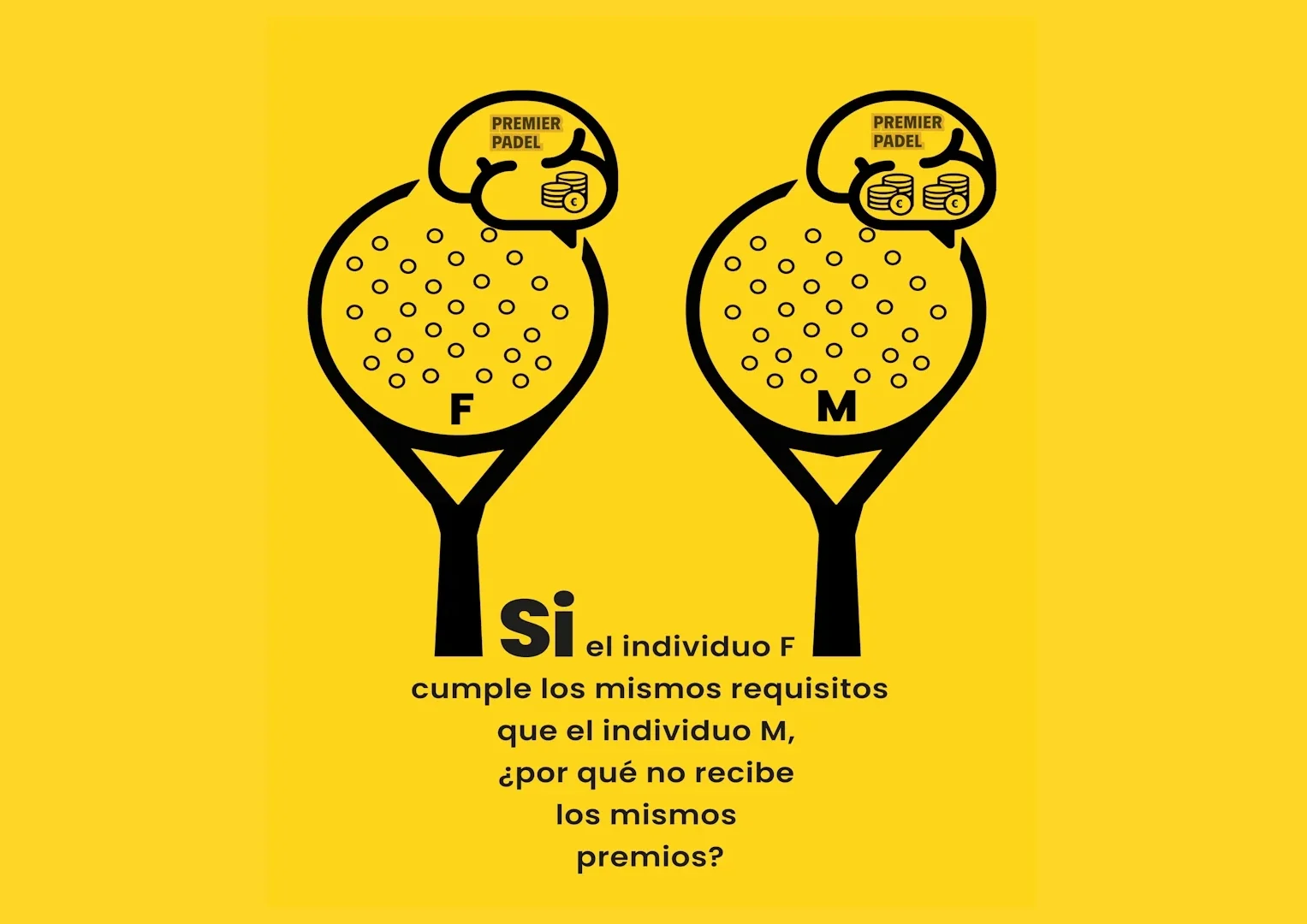
But then, if the regulations are the same and individual F meets exactly the same requirements as individual M, why does she not receive the same awards in all tournaments?
That is the great unknown that continues to linger in the minds of the players.
Ángela, one of the most veteran players, pauses for a second to assimilate the victory. After ending a career in tennis, she found in Padel an opportunity to satisfy the " itch for training and competing," and for her, every match feels as if it were the first.
Currently, she acknowledges that Padel "is already a lifestyle, it occupies all her time," and throughout her career she has been able to accompany the evolution of the professional circuits – from Pro Padel Tour (PPT), to World Padel Tour (WPT), and today, Premier Padel (PP) – noticing a common factor among all of them: "The men are here," she says, raising a hand to the height of his eyes, "and the women are below when it comes to salaries."
If the tournament that had just been played had been part of the Cupra FIP Tour (the secondary circuit coordinated exclusively by the FIP), Nico Cruz would have assured that the landscape is changing, that "all decisions that can be made in pursuit of equality are made," so the prizes would have been distributed fairly in both categories.
What's more, I would even have stated that if there were eight quarterfinal matches, three men's and three women's would be scheduled on the main court, while one men's and one women's match would be held on the secondary court, thus ensuring an equitable allocation of courts and visibility. And, very likely, I would also have cited the 2024 Qatar World Team Championship as an example of a competition in which the FIP decisively supported equal prize money and parity in team composition, in line with the principles promoted by the Paris 2024 Olympic Games.
But that has not been the case. The contested final belongs to Premier Padel (PP). More specifically, a P1 tournament, which means that today the female champions will go home with 35.3% less prize money than male winners.
Of the three categories that make up the circuit, only one has committed to equalizing the prize money starting in 2026: the four Major tournaments (the most prestigious events on the calendar). A statement of intent that, for the moment, is not reflected in its own Rulebook.
Meanwhile, in the ten P1 tournaments and the ten P2 tournaments, the gap remains in place. This is not a circumstantial situation, but rather a decision by Premier Padel endorsed by the International Padel Federation, since it holds a seat on the circuit's board of directors, along with the investment fund Qatar Sports Investments (QSI).
But why has it been decided that the value of the sporting effort of individual F is lower than that of individual M in those tournaments? Does anything change between them? The answer is unanimous among the various female and male players and coaches: no.
Among them, Javi Peña, director of the La Red 21 academy, states it emphatically: 'there is no difference; really, the effort and the requirements are the same in all tournaments and between the female and male categories.'
Within the court, the rules of the game are the same, the court conditions are the same, the punctuality is the same, the rest times are the same, the same three minutes are allotted to use the restroom or to change clothing (which, furthermore, must comply with the same regulations in both categories), the same code of conduct applies, and the same penalties are enforced.
Off the court: the same expenses on training, physiotherapy, and everything that comes with the professionalization of the individual; the same costs for travel, hotels, registration fees, and federation licenses; the same care and attention in their conduct and public statements so that these do not affect the image of the circuit or the federation.
Even so, at this point, all of the female individual's effort seems to lose its meaning.
In Ángela's gaze, a discontent tempered by a certain resignation is apparent, the result of the fatigue from this old narrative. After having gone through circuits where that inequality was also tangible, the players hoped that Premier Padel, born in the second decade of the twenty-first century and in a society increasingly attentive to people's rights, would bring a breath of fresh air to women's sport. But it has remained nothing more than an illusion.
When the men's final concludes and the awards ceremony takes place, Ángela and María will receive their trophies from the hands of the president of the FIP; an entity committed to equality, which encourages national federations to follow the same path and aspires to be a signatory of the Brighton Declaration, and which, however, has speeches that prove contradictory from the very first minute of the circuit in 2022, when it approved the existence of the prize money gap in its regulations.
Once again, when money comes into play and business overshadows sport, tension rises and judgment becomes clouded. The problem is that those who set the rules are off the field, and instead of wearing sports attire, they wear suits; instead of holding a racket, they hold a pen with which they sign checks and contracts. These can determine the course of an entire sporting career.
Digging into the memory of the players, both María and Ángela remember the year 2023 with a bittersweet taste. At that time, faced with the imminent disappearance of the then main professional circuit WPT, Premier Padel moved its pieces. After a year of exclusively male competition, it decided to present its proposal to the women's draw.
Those who lived through those days remember that the negotiating conditions were rather harsh: a long-standing document, drafted in English, difficult to access—to the extent that today no one seems to have a copy—and presented with a very short period for its assessment.
The decision was not unanimous. In the corridors of the International Association of Professional Female Padel Players (IPPA) – an organization created at the beginning of that same year with the intention of facilitating dialogue between the circuit and the athletes, and through which the contract was negotiated – the voices of those who believed that signing it would jeopardize not only their careers but also those of future generations were resonating.
Ana and Rita are two young women who aspire to become professional players. At that time, when the moment came to sign the contract, they did not even read it and placed all their trust in their representatives. There also did not seem to be many alternatives for those who dreamed of making their way among the best. After all, the monopoly of the circuit dictates that, to compete at the highest level and aspire to be number one, today there is no other path than Premier Padel.
Looking back, several professionals wonder what would have happened if they had rejected that first proposal and waited a little longer. "In the end, if the federation aimed for Padel to become an Olympic sport, female participation was mandatory. Perhaps we could have pushed a little more on the prize money to bring it closer to equality."
However, the echo of the threat of losing a season on the main circuit and the certainty that 'living off the tournaments of the Cupra FIP Tour is not viable, since the prizes do not cover the expenses' ultimately silenced the dissenting voices. The final result was the signing of a contract lasting more than twenty years, in which the inequality in the prizes was already evident.
Now, while the IPPA promotes the professionalization of women's Padel and supports the players in each tournament to ensure their well-being, a substantial part of its work remains focused on addressing that gap.
While it is true that progress toward equality is gradually being observed, doubts persist regarding the potential conflicts of interest posed by an association whose board of directors is composed of active players themselves. Instead of focusing solely on their athletic performance, these players end up dedicating part of their time and attention to managing matters of this nature, with the added constraint that any decision may directly affect their own professional careers.
In the twenty-first century, respect and human dignity should not even be a matter of debate. The work of professional athletes should be recognized equally in both categories when the demands and sporting requirements are the same.
Anyone observing from the center of the court sees a pavilion filled with advertising. On the screens surrounding the court, the logos of various sponsors appear: Adidas, Qatar Airways, Wilson, Bullpadel, Head... On the players' benches, Red Bull coolers. In one of the corners, a car, as per the standard of the Cupra brand.
Will all companies be aware that they are associating their image with a tournament that perpetuates economic inequality between men and women?
Will they be equally aware that many female fans and consumers are beginning to look at those brands with different eyes?
If the promoters and sponsors of the tournaments had proposed specific discounts for individual F, another type of debate could have arisen. If the circuit had suggested reducing registration fees in women's tournaments or granting specific assistance, another type of debate could also have arisen. If society itself had established aid or facilities in the basic services consumed by individual F, likewise, another type of debate could have arisen.
But this has not been the case. At no time has it been argued that individual F pays less for the goods and services they consume or that their lifestyle is less costly than that of individual M, so as to justify receiving lower compensation for their work. None of that. They face the same expenses as they do, exert the same effort as they do, and make the same sacrifices as they do; therefore, logically and coherently, their rewards should be equal.
For María, it is a matter of 'individual justice; that the sports issue is fair, that the ranking truly reflects the position or the level at which we are playing, because we are becoming more and more professional, but our effort is not being sufficiently rewarded economically.'
Like her, other players equate their effort to fighting against a wall. And that wall is the one erected by the offices of Premier Padel, where the old narrative still resonates—that men's sport generates a greater spectacle and attracts a larger audience and that, therefore, it deserves higher compensation.
But the competitive leap that women's Padel has experienced is undeniable. Endowed with its own rhythm and increasingly frantic, more intense, fast, and aggressive, the players are not the only ones who agree that this evolution "is attracting many more people to women's padel," both on and off the court.
In the stands, there are all kinds of profiles: from those who play Padel –whether as a hobby or dreaming of pursuing it professionally– to those who simply enjoy following this sport. However, opinions seem to agree that 'the beauty of Padel does not lie in the intensity, but in the intelligence with which it is played.'
The fans themselves acknowledge that men's matches «grab attention because of their speed, smashes, and power. But women's matches captivate because of the variety of shots. Above all, those of us who play Padel learn much more about technique and tactics by watching the women play. You understand why they chose to hit a lob instead of a 'viper'. Moreover, it draws you in because it makes you want to try those same moves the next time you step onto the court with friends».
However, most promoters seem not to perceive the engagement potential that women's Padel has and continue to argue that it is not enough to fill stadiums. But how is it going to do so if its matches are scheduled on a Thursday at nine in the morning when most of the audience is at work? Even “a Sunday at nine in the morning is not the same as a Sunday at eleven or at noon,” reflects Ángela, after having experienced it firsthand.
It is also not the same to play on a main court as on a secondary one, especially when the match is followed from home, where there is often no commentary and only a single static camera is available. A scenario that, in the opinion of many fans, "proves tedious." Furthermore, in Premier Padel tournaments there is a clear tendency to place women's matches on secondary courts, even when, based on ranking, they should be played on the main court.
And, on the other hand, how can the stands be filled if, with a circuit whose main owner is Qatar, numerous tournaments are held in that area? «We cannot fight against culture. When it was the women's final of the 2025 World Doubles Championship in Kuwait, the stands were empty, but in Kuwait, if people do not go or have no interest in women in general…», points out María.
On the horizon, the Pro Padel League (PPL) is beginning to emerge, the first professional team Padel league. Founded in 2023 in the United States, it is inspired by the franchise model of the NBA and the NFL, which is arousing players' interest by promising greater stability through fixed salaries.
However, institutional frictions have not taken long to appear. 'When the PPL proposal arrived, Premier Padel began to give us problems,' explains María. The contractual situation leaves the players in a state of impasse since 'Premier Padel demands full commitment; we had signed an MOU that, due to the clauses of exclusivity, it makes it difficult for us to confirm our presence to the PPL.
Even so, María recognizes that this new format could entail a disruption in the way Padel is perceived, by providing guarantees that allow athletes to fully devote themselves to their careers without relying solely on the results of each tournament. It represents a new way of conceiving this sport, increasingly moving away from its current models, which are inspired by tennis.
Women's Padel needs its recognition. On the court, there is no room for differences or inequalities, or at least there should not be. The female body is required to perform exactly the same as the male body, and both bear with the same commitment the weight of that demand. Travel, expenses, and distance from family and loved ones are common aspects of the path for those who aspire to be professionals. All these steps are not invisible, but essential to reach the court. Once inside and the match has begun, the only one that should speak is the scoreboard, as it is the only one capable of defining who wins and who loses, and its language is identical for everyone. Consequently, the prizes should be as well.
At this point, 'there is no choice but to continue fighting for the situation to improve,' the players agree. The IPPA does what it can. The public supports them, recognizes their effort, defends equality in the prizes, and admits that they would pay for a ticket to attend exclusively female tournaments. There are more and more supporters, and female Padel is increasingly generating interest.
Now it only remains for the FIP to align its actions with its words. If it wants to position itself as a signatory of the Brighton and Helsinki Declaration, as stated in its 2025-2028 Gender Equality Policy, it must act consistently throughout all its channels. Only then can Padel present itself to the world as a true benchmark of equality and parity in contemporary sport.
Which 8 Argentine players do you think will be selected for the 2026 World Cup?
Keep an eye on your email:
we’ll send you notifications so you can stay updated on the latest news.